Case Study
SaaS-Based ERP Platform
Multi-Tenant SaaS Architecture
Architected a 6-service multi-tenant ERP platform with tenant provisioning, billing controls, RBAC, and gateway-based shard routing serving multiple business tenants.
ASP.NET CoreEF CorePostgreSQLNext.js 15ViteRedux ToolkitSignalRDockerAWS ECRGitHub Actions
Role
Backend and platform engineer with architecture ownership across all 6 services.
Business Problem
The company needed to serve multiple business clients (trading, retail, services) from a single platform without data leakage between tenants, while allowing each tenant to enable/disable modules based on their subscription. The system needed to scale horizontally — adding new tenants without redeploying existing ones — and support branch-level access control within each tenant.
Key Decisions
- Chose subdomain-based tenant routing through a dedicated proxy API rather than shared-database multi-tenancy, ensuring complete data isolation per tenant with separate PostgreSQL databases.
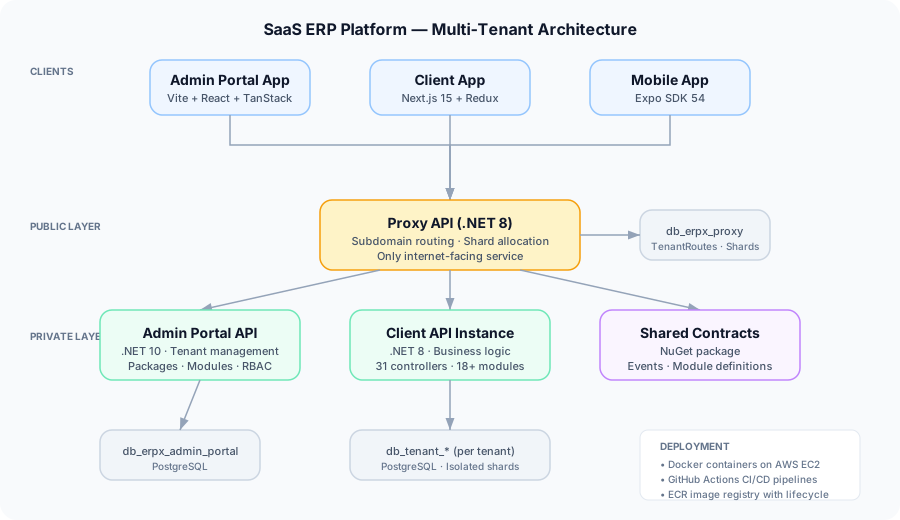
- Designed a 3-tier architecture: Admin Portal (tenant management) → Proxy API (routing + provisioning relay) → Client API instances (business logic), keeping only the proxy internet-facing.
- Implemented a shared contracts NuGet package for cross-service event definitions, ensuring type-safe communication without tight coupling.
- Built a shard allocation system with capacity tracking — the proxy automatically assigns new tenants to the least-loaded Client API instance.
- Used EF Core with per-tenant connection strings resolved at runtime via middleware, avoiding the complexity of database-per-request patterns.
Architecture
- Built a proxy gateway that routes requests to tenant-specific PostgreSQL shards based on subdomain resolution.
- Designed domain event flows with shared contracts for cross-service module communication.
- Implemented admin operations for provisioning, module toggles, and subscription controls.
- Created a provisioning chain: Admin Portal → Proxy API (shard allocation) → Client API (user/role/permission seeding).
- Built branch-level RBAC with permission caching middleware for sub-100ms authorization checks.
Architecture Diagram
Outcomes
- Enabled scalable tenant onboarding — new tenants provisioned in under 30 seconds with full isolation.
- Supported 18+ business domains with consistent module design and release patterns.
- Achieved zero cross-tenant data leakage through architectural isolation rather than application-level filtering.
Measurable Impact
- 6 independently deployable services across 3 server tiers
- 18+ domain modules (Sales, Purchases, Stock, Accounting, Payroll, Logistics, CRM, POS, etc.)
- 340+ EF Core migrations managed across the platform lifecycle
- 31 API controller groups in the Client API alone
- Sub-30-second tenant provisioning with automated role/permission seeding